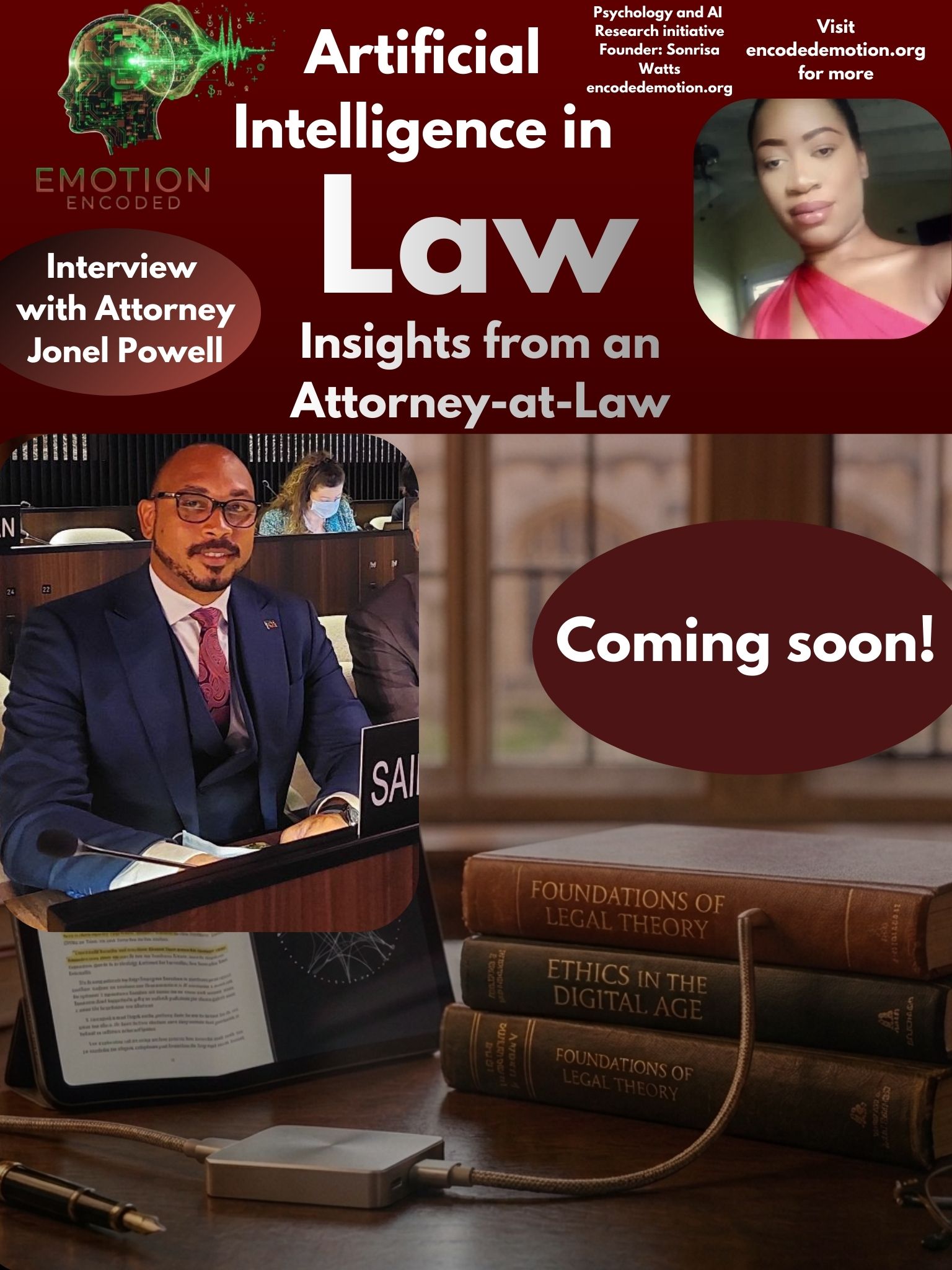
For the latest expert series at Emotion Encoded, I got Attorney Jonel Powell’s insights on what happens when clinical instinct meets a computer program. We talked about the reality of legal liability and why "Explainable AI" is actually just a new way for experts to get tripped up in a small country.
Jonel Powell is a Kittitian attorney and the Managing Partner at Grant, Powell & Co. He served as the Member of Parliament for Central Basseterre and was the Federal Minister of Education, Youth, Sports, and Culture from 2020 to 2022. Known for modernizing vocational training through the TVET project and representing the federation as an Ambassador at Large, he remains a key figure in the legal and political landscape of St. Kitts.
When we talked about the danger of "convincing" AI, Jonel was clear that "as convincing as an explanation may seem, one should always verify the veracity of the explanation from a trusted authority particularly if you do not understand it." This is exactly what I call "fluency bias." AI is great at sounding smart and logical, which can trick even a pro into turning off their own brain. In a small place like St. Kitts, if an AI says something "convincing" but you can't back it up with a local authority, you're walking into a trap. The real danger isn't that the AI is wrong, it is that it sounds so confident that the lawyer stops asking questions.
He also said that "AI provides a fast and sometimes 'shortcut' approach in the legal field, which can entice lawyers to rely on the perception of its efficiency, sometimes to their detriment and even that of their client." Efficiency is basically the bait. Since legal research in the Caribbean takes forever, a shortcut tool is hard to turn down. But the risk is that speed starts to matter more than actually being right. If a lawyer starts choosing the fast way over the deep dive, the client is the one who ends up paying for that "efficient" mistake.
The biggest issue is that AI basically has zero "island intelligence." Jonel noted that "it would be foolhardy to solely rely on AI in determining a legal dispute as it lacks the human elements of discretion and sensitivity. The underavailability of our local legal resources can also lead to incomparable substitutions by the AI resulting in flawed reasoning and outcomes." Because Caribbean law isn't all over the internet like US or UK law, the AI just starts guessing. It uses "incomparable substitutions," which is a another way of saying it uses foreign logic to try and solve a local problem. Without a human judge to add in that actual sensitivity and local context, you get a decision that looks okay on paper but is totally flawed for our reality.