The Cognitive Boundaries of Algorithmic Trust in Caribbean Jurisprudence
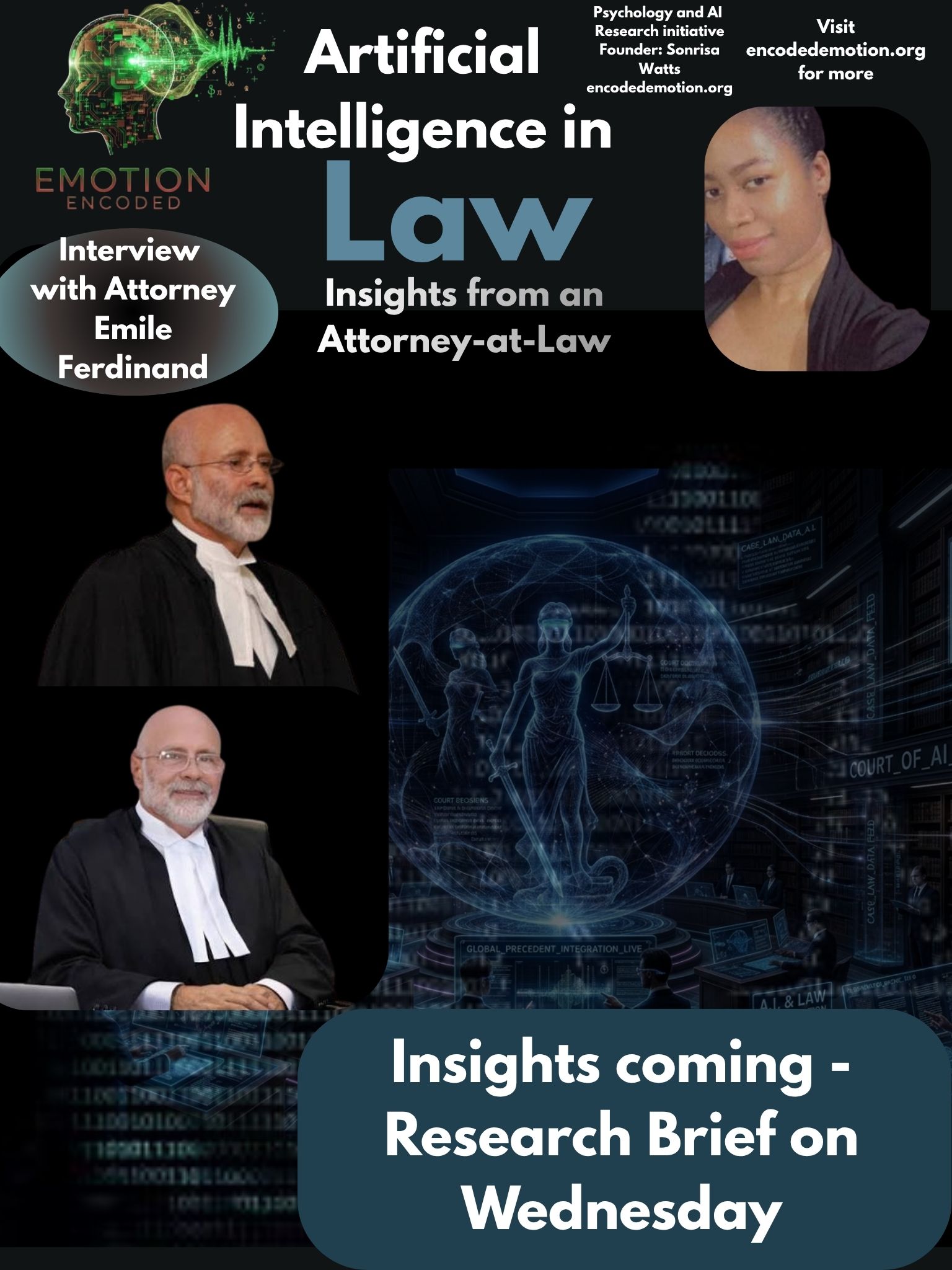
Emotion Encoded conducted a qualitative interview with seasoned attorney Emile Ferdinand to examine trust calibration between human intuition and Artificial Intelligence in legal practice. Drawing from decades of Caribbean legal experience, Ferdinand argues that while large language models excel at data retrieval, they fail to grasp localized context and moral accountability. True legal expertise requires letting materials percolate, a slow cognitive process that rapid automation actively threatens.
Finding 1: The Soul of Legal Practice and Human Liability
The primary hazard of modern legal technology is automation bias where practitioners offload critical thinking to software. Ferdinand emphasizes that jurisprudence is built on human experience rather than pure mathematical deduction.
Drawing on legal history, Ferdinand noted that "the life of the law has not been logic, it has been experience." Using shortcuts to bypass this experience creates active dangers for practitioners. Ferdinand quoted another prominent lawyer, Charles Henville, warning that "shortcuts lead to hell." To illustrate how easily humans fall for the illusion of AI intelligence, Ferdinand shared a story from a Jamaican lecturer, Dennis Morrison, who tested a conversational AI to see if it could decipher human emotion. "Everything he ask AI answer. Alexa do u love me? Alexa say I just met you Dennis." Ferdinand noted that Morrison asked her that because he wanted to say if he can decipher it since he think is real. Ferdinand highlights this to show how easily users project real humanity onto algorithms. In high-stakes practice, this projection is dangerous because you cannot offload your professional duty. Ferdinand warns, "The crucial thing is you can't delegate your responsibility to AI and say well is AI tell me this."
Finding 2: The Shift in Mentorship and Accelerated Error
The traditional training ground for junior associates involves reading dense case law and doing basic document review. Automating this process changes how expertise is formed. Ferdinand cautions that removing this friction does not make new practitioners smarter.
He notes, "All it does is make them make more mistakes faster." Practitioners must remain vigilant and be careful to backcheck automated outputs. When clients seek legal representation, they come to you for your judgment and experience, not for a computerized output. Ferdinand notes that just as you cannot rely on any random book since some books are more authoritative than others, you cannot rely on AI just because it sits on a computer. Ethical verification remains a mandatory human duty.
Finding 3: Deep Work vs. The Speed of Information
The conversation revealed a parallel between AI automation and modern shifts in education. Ferdinand contrasts the modern semester system with older, more rigorous academic structures to show how the brain builds expertise.
Ferdinand argues that the older system, where students had to sit comprehensive year-end examinations, was superior because it forced students to sit with concepts over time. He noted, "I found that letting the materials percolate than trying to do a lot of different subjects is a better way to learn law than the semester system." Ferdinand argues that modern information structures focus on just turning in information so far, meaning students fail to grasp the deeper linkages between concepts until much later in their careers.
Finding 4: The Kim Collins Blind Spot and Hyper-Local Context
A massive barrier to deploying global AI models in the Caribbean is their inability to process unique regional profiles. While an LLM can calculate the global average compensation for personal injury, it cannot compute the cultural weight of that injury.
Ferdinand used a striking local example to illustrate this gap. While AI can be incredibly useful to search Caribbean case law, a practitioner cannot just run with the output. Ferdinand noted, "You could look for a lost leg West Indian cases, but you still have to look at what that particular individual do. Because if Kim Collins lose he leg, you wouldn't know, the AI wouldn't know who is Kim Collins." While an algorithm can search global databases to find standard payouts, it does not understand the localized context of a national icon. Human intuition and local awareness cannot be replaced by data scraping.
The interview with Emile Ferdinand validates the core thesis of our research. High-stakes practitioners view AI as a data-retrieval mechanism, not a decision-making peer. To prevent automation bias, AI must be treated like a non-authoritative textbook: useful for research, but never a substitute for human judgment and localized Caribbean experience.
Sonrisa Watts // Emotion Encoded // 2026