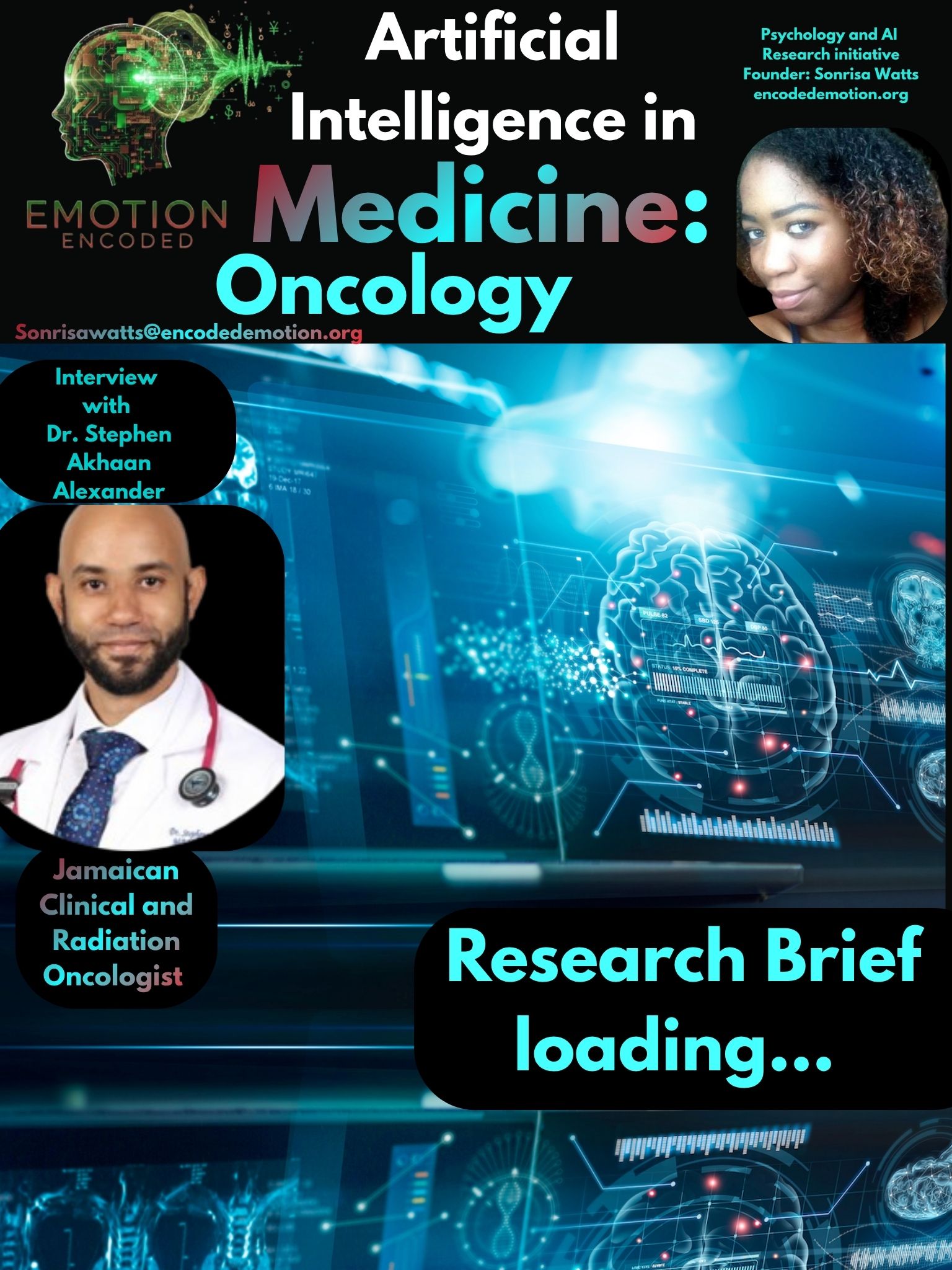
Emotion Encoded: Artificial Intelligence in Oncology
Dr. Stephen Akhaan Alexander
When AI enters the oncology clinic, where treatment plans are obsolete in minutes and data can be skewed, how does a master clinician decide when to trust the machine? Dr. Alexander, a Consultant Radiation and Clinical Oncology specialist based in Kingston, Jamaica, explores the psychological thresholds where clinical wisdom must align with algorithmic logic.
Question: When a colleague explains a decision, they use logic. When an AI tool explains a decision, what do you actually need to see to believe it?
"To believe the results of AI, I must have a good understanding of the subject matter, though my logic may not give me the correct answer, my logic and that logic of the AI should align, linking to a medical article will help but bear in my mind that data in these articles can be skewed. Please note that having a good understanding of the subject matter will require years of clinical experience coupled with evidence based medical studying."
Dr. Alexander highlights that logic alignment is the true metric for belief. Even if the AI provides a medical paper, a seasoned oncologist remains skeptical because they know data can be biased. True verification requires a subject matter expertise that only comes from years of clinical experience. AI doesn't replace the expert; it must audition for them.
Question: In a few years, can you see a situation where ignoring an AI's treatment plan feels more dangerous than trusting your own gut?
"Yes, this may be a possibility, AI is becoming comprehensive, constantly being upgraded and remodelled with knowledge and experience from real physicians... AI will provide knowledge and experience of hundreds of medical doctors, so If AI has a different solution to a medical problem than myself that would require a rethink on my part."
We are moving toward a Collective Authority. When an AI is modeled on the cumulative knowledge of hundreds of physicians, a deviation from the machine is not so much of a just a gut feeling but more of a prompt for a rethink. Dr. Alexander views AI as a high-level peer review that forces the clinician to verify their own decision-making.
Question: If a patient asks 'Why did this happen?', should an oncologist blame a glitch in the AI software they used?
"Mistakes will happen whether It was an oncologist decision or not... AI is a tool that an oncologist uses; the final decision rests with the oncologist who has undergone training coupled with experience."
In oncology, there is no room for blaming the glitch. Dr. Alexander firmly anchors professional accountability in the human expert. Because patient vitals can become obsolete in minutes, the AI is relegated to its proper place: a tool. The final decision, and the weight of it, rests solely on the clinician.
The oncologist’s expertise acts as the final filter for machine intelligence. AI is respected as a comprehensive knowledge aggregator, but it lacks the situational agility to handle a patient whose status changes in minutes. Trust is a product of alignment.
Sonrisa Watts // Emotion Encoded // 2026