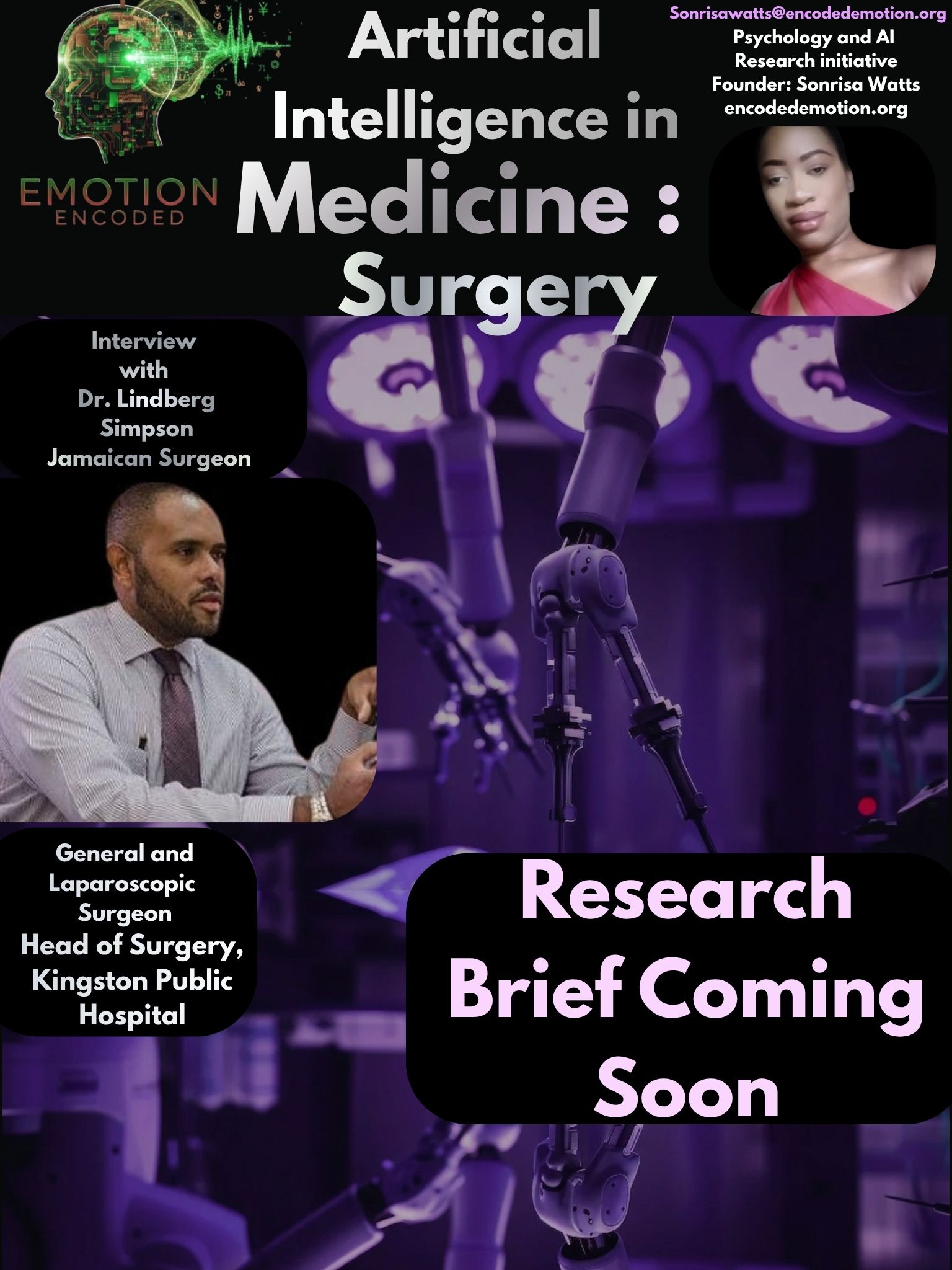
Emotion Encoded: Artificial Intelligence in Surgery
Dr. Lindberg Simpson, Head of Surgery at Kingston Public Hospital
I spoke with Dr. Lindberg Simpson to analyze how high-stakes surgical operators evaluate explainability and accountability in automated systems. Dr. Simpson is the Head of Surgery at the Kingston Public Hospital in Jamaica, a Fellow of the Caribbean College of Surgeons, and a Founding Member of the Caribbean Society of Endoscopic Surgeons. Operating at the peak of regional clinical practice, his insights reflect the perspective of a seasoned specialist who views technological advancement through the lens of ultimate professional liability, advanced technique, and patient safety.
The Explanatory Map
Question: When an AI suggests something in surgery, would you prefer to see a 3D reconstruction of the surgical field, or a written justification for the AI's suggestion? Or both?
Dr. Simpson Response: I would like to see both the 3D reconstruction as well as hear the justification for the suggestion. I think this could improve outcomes. The 3D reconstruction would be very helpful but at this stage of the evolution of AI, I would like to understand what made the AI make that recommendation.
Insight: Visual tools alone are insufficient at this stage of AI development. While a 3D reconstruction provides spatial utility, senior surgeons require explicit insight into the underlying logic of a machine's recommendation before altering their clinical course. Trust is built when spatial mapping is paired with transparent, explainable reasoning.
Verifying the Logic
Question: Which one do you think helps you better to trust an AI answer in surgery? Do you want to see how the AI identified the problem and its decision or do you prefer to see how it ruled out other possibilities?
Dr. Simpson Response: I think both options are important to make an informed decision especially as the decision may have serious repercussions. Also, there may be other mitigating circumstances which the AI may not be aware of, or there may be other possibilities that might be better suited in this circumstance. So I would like to have both pieces of information.
Insight: Surgeons operate under a dual-verification mindset. To make an informed decision when stakes are high, an expert needs to see both the positive case (how the AI identified the problem) and the negative case (how it ruled out alternatives). This comprehensive view allows the surgeon to cross-reference the machine's logic against real-world mitigating circumstances that the algorithm might completely miss.
The Accountability Boundary
Question: The newer generation of surgeons will see surgery in a different way when AI is involved in decision making. In your opinion, if the AI is wrong, is it malpractice or a system error?
Dr. Simpson Response: The best use of AI is where it facilitates faster and better decision making by surgeons and hopefully help to avoid potential errors. But the final decision and responsibility must remain with the surgeon who is responsible for the patient. The managing surgeon must utilize all the information at his/her disposal to come up with the correct decisions and perform the correct procedure in the best possible way. So in that sense, the AI is like a CT or MRI in helping us improve outcomes. I'm saying that to say if the AI is wrong or makes an incorrect prediction and the surgeon makes an incorrect recommendation, and there is an unfortunate outcome, that would be malpractice. However, if the AI does make an incorrect recommendation, and this is recognised as incorrect or the incorrect recommendation for the scenario, then that becomes a system error and needs to be analysed to improve outcomes.
Insight: Technology changes, but the locus of responsibility does not. AI is categorized strictly as an advanced diagnostic tool, comparable to an MRI or a CT scan. If a surgeon blindly follows a flawed algorithmic prediction into a poor patient outcome, it is malpractice because the human remains the final arbiter of care. The error only shifts to a system error if the human expert successfully intercepts the machine's flaw, allowing the software defect to be isolated and corrected without patient harm.
Research Verdict
Conclusion: Talking with Dr. Simpson establishes that expert trust in surgical AI requires total transparency, both in spatial reconstruction and logical justification. Ultimately, AI must serve as an efficiency accelerator rather than a liability shield, leaving absolute professional accountability squarely in human hands.
Sonrisa Watts // Emotion Encoded // 2026