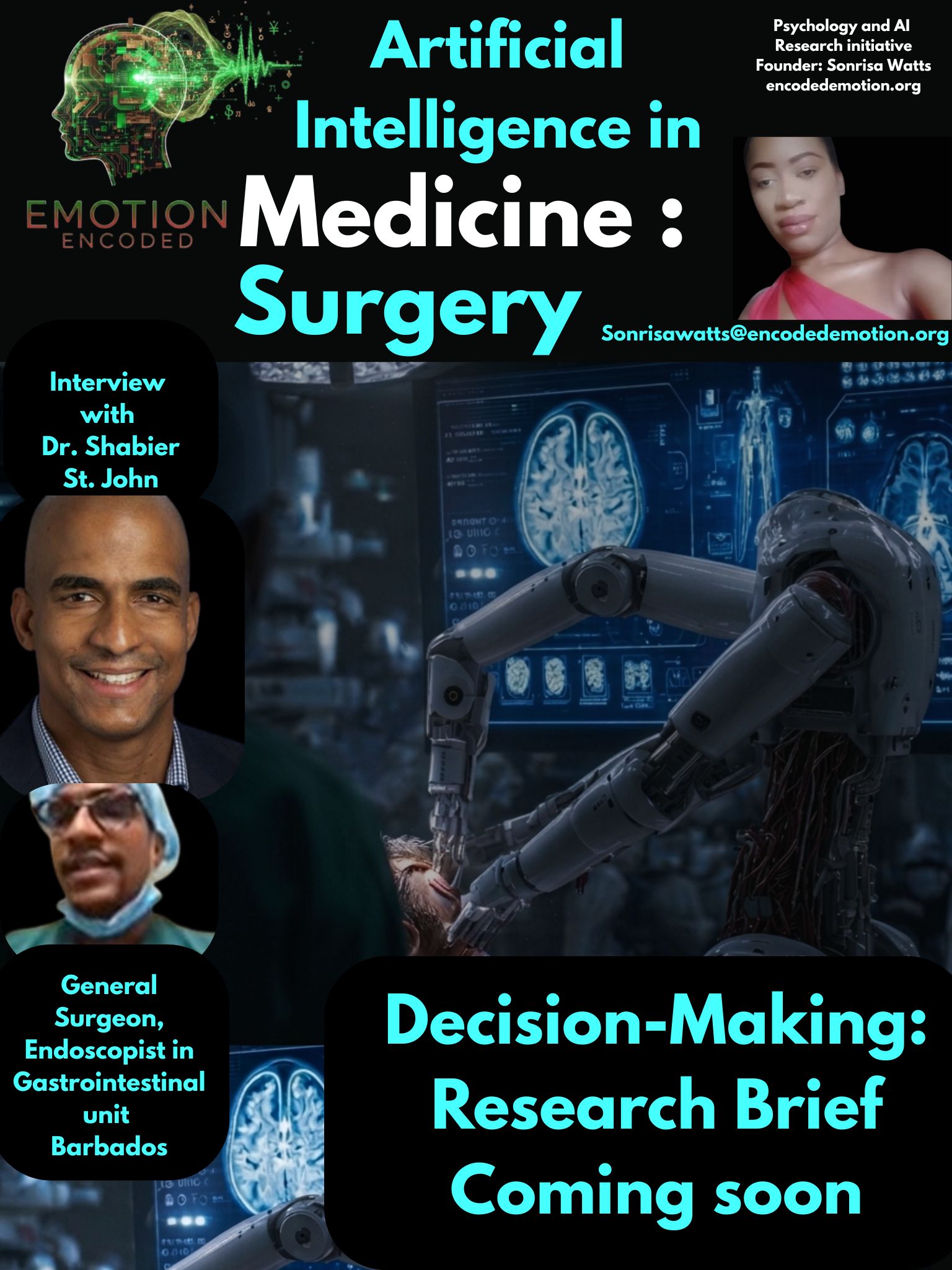
Emotion Encoded: Artificial Intelligence and Decision Making in Surgery
Dr. Shabier St. John
I’m obsessing over why high-stakes experts might be rejecting 'perfect AI', and I don't think it's because they are tech-phobic. It’s because the tools the world is building might be fundamentally broken for the real world. I interviewed Dr. Shabier St. John, a Colorectal Surgeon and Endoscopist operating in Barbados who's exactly the person whose life gets harder when a tool doesn't account for accountability.
Question: Which do you prefer: a "black box" AI that is 99% accurate but can’t explain itself, or a human colleague who is 70% accurate but can explain every step?
"I prefer a human colleague who is less accurate but can explain every step. This justification is important to both the medical team and the patient and their relatives. Often patients need full disclosure in order to exercise autonomy."
This suggests that Traceability > Precision. Dr St. John is doubling down by saying that in surgery, a "why" is a survival requirement for patient autonomy. If you can't explain the move, it wouldn't be ethical. This is why "black box" logic is a non-starter in an OR; it strips the human out of the ethical loop.
Question: In the middle of a procedure, can you picture AI being a necessity rather than just a 'back check' tool?
"Yes in cases with difficult anatomy if AI can be integrated with pre-operative images and real time anatomy it could be helpful. Some procedures require skilled assistant not always available and AI can assist with this once correctly calibrated."
Question: In your opinion, who bears the weight of a surgical error if you were just following the AI's lead? Surgeon or AI developer?
"Under current legislation the surgeon bears responsibility as AI and its developer is just a tool. When a surgeon has a complication due to equipment failure the developer of the equipment is not responsible. Until legal frameworks change AI can not be held responsible."
Interpretation: The Liability Trap
Since current laws treat AI like a scalpel, the developer has zero skin in the game. The surgeon takes 100% of the fall. This forces experts into a 'babysitting' role, expending massive mental energy double-checking a machine they are already legally responsible for. This Manual Verification Burden is the real barrier to adoption.
Traceability > Precision. Justification is vital for medical teams.
AI could assist in difficult anatomy once calibrated.
The Fall Guy: Surgeon bears 100% responsibility.
The world is building high-performance engines but Dr. St. John’s reality shows that experts don't want smarter boxes; they want accountable partners. Until AI can provide a "why" alongside its "what," the cognitive cost of using it will always stay higher than the benefit. For the surgeon, the risk is absolute and for the developer, it’s zero.
Direct Inquiries: ST_JOHN_FINAL
National Impact // Emotion Encoded
I had no institutional backing, no team, and no funding: just agency and drive. I founded this project because I needed research experience but had no access to traditional research opportunities, mentors or labs.
Sonrisa Watts // Emotion Encoded // 2026