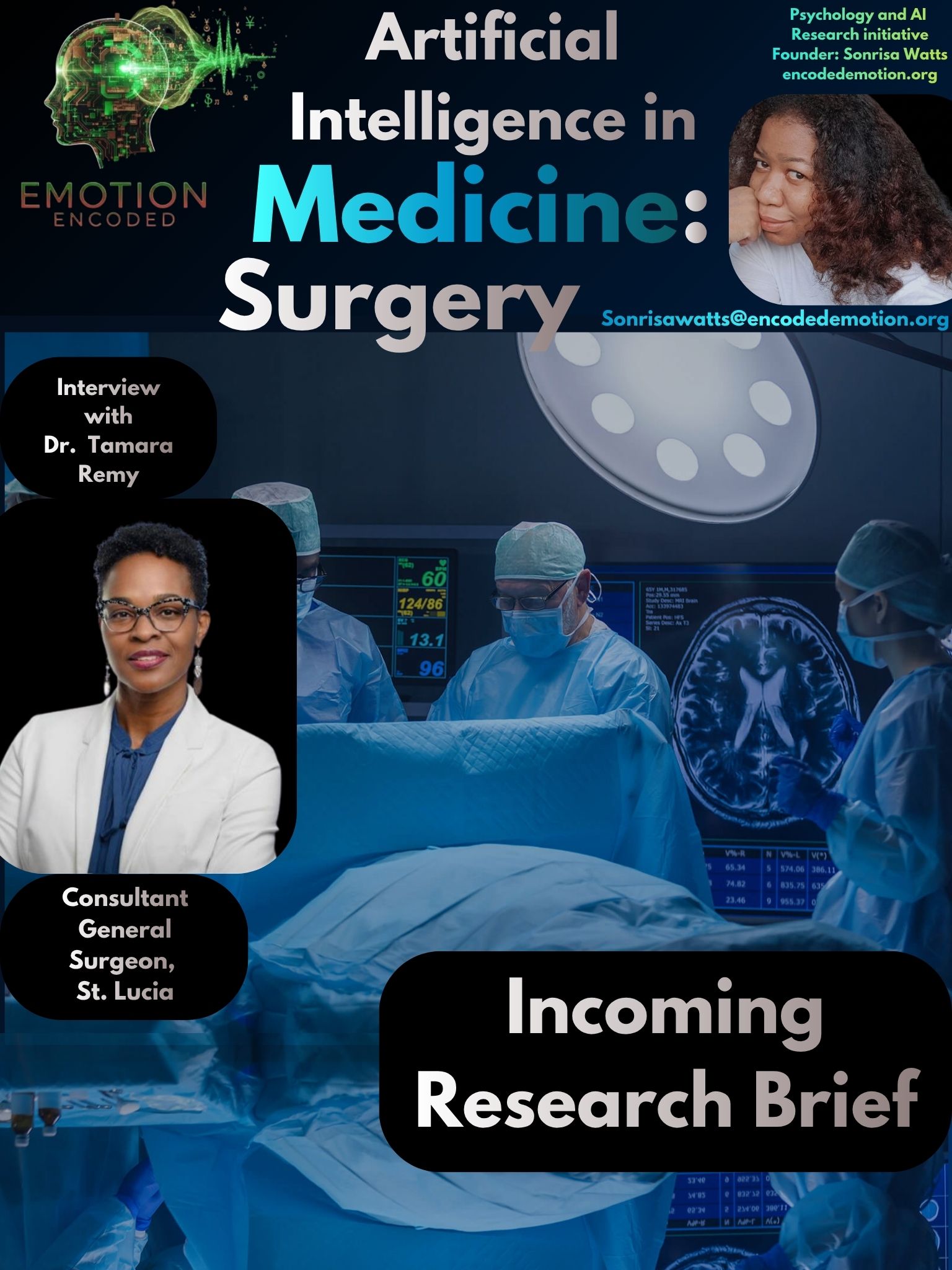
Emotion Encoded: Artificial Intelligence in Surgery
Dr. Tamara Remy, General Surgeon
I spoke with Dr. Tamara Remy, a St.Lucian general surgeon, to see how someone in the operating room feels about AI actually helping with a procedure in real time. Dr. Remy is a General Surgeon at Drax Hall Medical and Surgical. She handles a wide range of surgical cases, focusing on the standard of care and the safety of the operating environment. Her experience is grounded in the reality of clinical work, where success depends on the specific hands of the surgeon and the unique factors of every patient.
The Practical Map
Question: In Using AI In surgery, Would you rather see a highlighted map of the surgical site, or a probability score of the outcome?
Dr. Remy Response: A highlighted map of the surgical site – hopefully with the anatomy etc. Outcome is dependent on so many things – surgical technique, patient factors etc – unless the probability score took into consideration each surgeon (with their techniques and patient factors). The highlighted map may be more useful.
Insight: Surgeons seem to value visual guidance over abstract numbers. A score feels a bit too detached when you are actually in the middle of a procedure, especially since so many tiny variables from the patient or the surgeon's own style change the outcome. A map is a tangible tool for the present, while a probability score feels like a guess that might miss the messy reality of a real human body.
Mistake Prevention
Question: What would be your preference: should the AI highlight what you should avoid, or what you should target next? Or both?
Dr. Remy Response: Most operations have set standard steps. So I would prefer AI to highlight what I should avoid.
Insight: Experience changes what you need from technology. When you already know the standard steps of a surgery, you do not need a computer to hold your hand through the basics. The real value for an expert is having a system that acts as a safety net to flag potential errors or structures to stay away from. It is about using AI for risk reduction rather than just following a digital checklist.
The Representation Gap
Question: Do you trust foreign AI to understand a Caribbean body?
Dr. Remy Response: As much as I would trust AI to differentiate between blacks and other minority groups versus Caucasians. The hope is that what is being inputed is as wide and varied as can be – using data from ALL or as many sources as possible. So from an anatomical perspective, may not be too different. From a genetic one (with respect to risk factors) and other factors for example that influence outcomes – that aspect would be more influenced by having a Caribbean body.
Insight: There is a big concern about whether AI built elsewhere actually works for us. While basic anatomy is the same, the things that change medical outcomes like genetics and specific regional risk factors, are where the Caribbean context really matters. If the data used to train these models is not diverse, the advice the AI gives might not be as reliable for people in our region.
Research Verdict
Conclusion: Talking with Dr. Remy shows that for surgeons, AI needs to be a practical partner that helps them avoid mistakes and understands the diversity of the patients they are actually treating.
Sonrisa Watts // Emotion Encoded // 2026