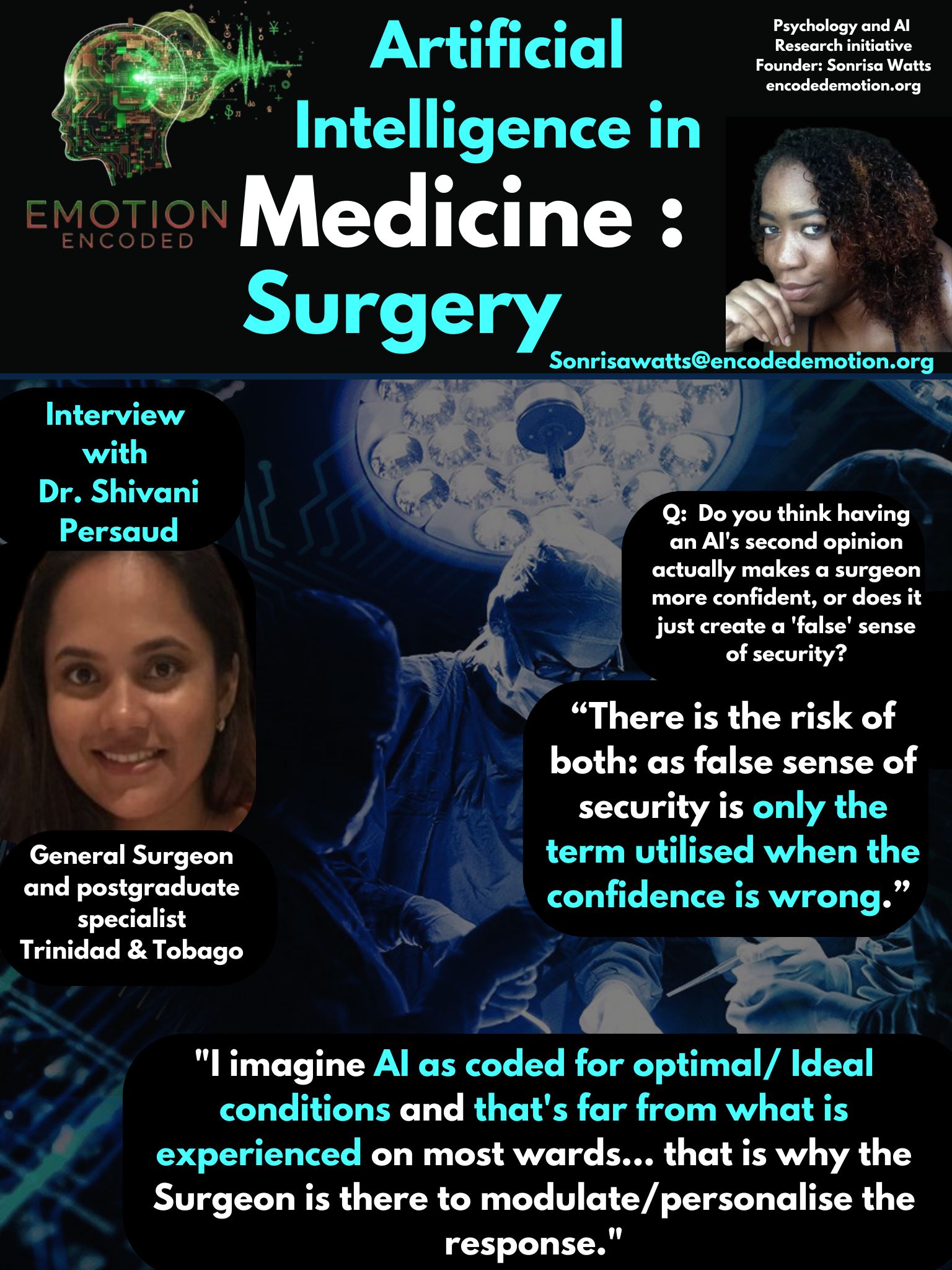
Dr. Shirvanie Persaud is a General Surgeon at the North-Central Regional Health Authority (NCRHA), practicing at the Eric Williams Medical Sciences Complex. She holds an MBBS and a DM in General Surgery from the University of the West Indies, St. Augustine, and is a member of the Royal College of Surgeons of Edinburgh.
Her clinical experience covers a high volume of complex cases in general, vascular, and thoracic surgery. Her research focuses on practical medical outcomes in the Caribbean, including studies on critical limb ischemia and emphysematous infections. She is committed to patient-centered care and evidence-based surgery within limited-resource settings.
Dr. Persaud shows that there is a big difference between the perfect settings AI is built for and the high-pressure reality of Caribbean hospital wards. AI is a strong tool for checking medical rules and looking for rare diseases, but it is limited because it is usually made for rich countries with more money and different cultures.
There is a thin line between feeling sure and having a false sense of security. Dr. Persaud says that we only call it false security when the confidence turns out to be wrong. To stay safe, the surgeon must check the AI's work carefully.
"There is the risk of both: as false sense of security is only the term utilised when the confidence is wrong. AI is a good tool to cross-check; aid in recalling/accessing guidelines and exploring rare and possibly forgotten differentials. Surely, the surgeon needs to critically appraise the content."
AI tools do not yet understand the specific stress of a Caribbean ward. These programs are made for ideal environments, so they do not get the local problems with equipment or culture. Dr. Persaud believes the surgeon must change and fix the AI's answers to fit the real world. However, there is hope for the future. Just as global health groups have made simpler medical rules for our region, Dr. Persaud believes there is hope for harmonised versions of AI tools specifically tailored to low resource populations.
"I don't think AI would understand the pressure of a Caribbean ward. I imagine AI as coded for optimal/ Ideal conditions and that's far from what is experienced on most wards. The programming likely considers high-resource settings and different socioeconomic and cultural backgrounds. However, I believe that is why the Surgeon is there to modulate/personalise the response."
Right now, Dr. Persaud uses AI for office work and organization rather than direct surgery or diagnosis. For figuring out what is wrong with a patient, the surgeon’s own skill is still the main authority.
"I do not use AI for any diagnostic or direct patient management purposes. My use of AI is only in the stage of cross checking guidelines; drafting patient letters and compiling and organising outpatient work and lists."
The main takeaway is that AI cannot handle the reality of a Caribbean ward on its own. While the technology is good for organizing paperwork and double-checking rules, it is not ready to make life-or-death decisions in a place with limited resources. The surgeon is the most important part of the process because they have to fix the AI's mistakes and make sure the data actually fits the local environment.
Emotion Encoded | encodedemotion.org